How to Encourage Children to Problem-Solve and Develop a Growth Mindset in Maths
Maths and English worksheets for your child's year group, made by Sunita, an experienced UK primary school teacher. Print them at home and sit together for ten minutes.

Free trial, no card
Try the classroom free for 7 days
Sign up free, pick your child's year group and print 3 worksheets this week. Made by a UK primary school teacher, yours to use at the kitchen table.
- ✓Made by an experienced UK primary school teacher
- ✓Mapped to the national curriculum, Reception to Year 6
- ✓Print at home and work on paper, no screen needed
No card needed. One teacher, every worksheet.

One of the biggest challenges primary school teachers and parents face is helping children develop confidence.
Many children feel nervous about subjects such as maths and believe they aren't "good" at it. Building a growth mindset can change this attitude, making children ready to tackle difficult problems.
Teachers and parents can work together to can create a growth mindset in the classroom, supporting key objectives from the National Curriculum for primary school maths.
What Is a Growth Mindset?
A growth mindset is the belief that abilities, such as math skills, can be developed through effort, learning, and persistence. Instead of thinking, "I'm bad at math," students with a growth mindset believe, "I can get better if I work hard and try different strategies."
For young learners, this mindset is especially important in math because children often feel discouraged if they don't understand a concept right away. Teaching them that it's okay to make mistakes and that everyone can improve helps to build their resilience and problem-solving skills.
Linking to the Primary National Curriculum
The National Curriculum for primary school maths emphasises several objectives that a growth mindset can support:
- Problem-solving:
Children are expected to solve a variety of math problems, often involving more than one step. Encouraging a growth mindset helps children approach these challenges with perseverance. - Fluency:
The Primary National Curriculum encourages fluency in key skills like number facts (addition, subtraction, multiplication, and division) and place value. When children struggle with these skills, a growth mindset encourages them to keep practicing until they improve. - Reasoning:
Children should be able to explain their thinking and how they reached an answer. Developing a growth mindset helps children understand that reasoning is part of the learning process, and even if they are wrong, they can reflect and learn from their mistakes.
Tips for Primary School Teachers and Parents to Encourage a Growth Mindset
Here are some simple strategies primary teachers can use in the classroom to encourage a growth mindset in math. Parents can also try these strategies at home to help further develop children's confidence. The focus is always on encouraging children to keep trying and learn from their experiences.
1. Celebrate Mistakes as Learning Opportunities
Teach children that mistakes are a natural part of learning maths.
Instead of focusing on being right, encourage them to think about what they can learn from their mistakes. You might say, "Mistakes help your brain grow!" This helps reduce fear of failure and promotes a positive attitude towards problem-solving.
For Example:
During a lesson on addition or when doing homework, a child adds 27 + 15 and gets 32.
Instead of just correcting the answer, you could say, "Great! You had a go at it. Let's look at where we might have gone wrong and how we can fix it together." Then guide the child through the steps again, asking them to check their place value (adding the ones and then the tens separately). This shows the child that making mistakes is okay and part of learning.
Why it helps:
The child feels comfortable with errors and sees them as chances to learn, not as failures.
2. Use Encouraging Language
Be mindful of the words you use in the classroom.
When a child struggles with a problem, avoid saying, "It's okay, you're not good at math." Instead, use phrases like "You haven't mastered it yet—keep trying!" This reminds them that they can always improve with effort and practice.
For Example:
A child might say, "I’m bad at multiplication."
Instead of agreeing or letting that mindset stick, try saying, "You're not bad at multiplication; you're still learning it. You just need a bit more practice, and I know you can get there!" If a child answers a multiplication question wrong, you could say, "That’s not quite right yet, but look how much closer you’re getting! Let’s try again."
Why it helps:
This language emphasises the idea that skills grow with time and effort, helping children stay motivated even when things are tough.
3. Model Perseverance
Show children that everyone finds certain problems difficult at times.
Share your own experiences of when you found something hard and how you worked through it. By modelling perseverance, you show that effort leads to improvement.
For Example:
Solving a tricky word problem in class or at home like, "There are 3 boxes. Each box has 5 apples. How many apples are there in total?" and pretend to struggle a little while talking through the problem out loud: "Hmm, let me think... I know I need to multiply, but let me double-check if I can break it down into smaller parts... Oh! I could add 5 + 5 + 5 instead of multiplying 3 × 5 if that makes it easier to see."
By doing this, you model perseverance and are showing that it’s okay not to get the answer immediately.
Why it helps:
When children see you working through challenges, they realise it’s normal to take time with problems and try different approaches.
4. Break Problems into Smaller Steps
Some children may feel overwhelmed by complex problems.
Help primary school children break problems into smaller, more manageable steps. This will not only reduce their anxiety, but also teach them that progress is made step by step, not in one go.
For Example:
If a child struggles with a problem like "345 – 128" they may feel overwhelmed. You could break it down by saying:
- "Let’s subtract the ones first: 5 – 8. Oh wait, we can’t, so we need to borrow from the tens column. Let’s change 40 to 30 and add 10 to the 5."
- "Now we have 15 – 8. What’s the answer? 7! We can now subtract the tens: 30 – 20... That gives us 10. Finally, subtract the hundreds: 300 – 100 equals 200. Now, let’s put it all together: 200 + 10 + 7 = 217."
Why it helps:
Breaking down the problem into smaller, manageable steps helps children see that solving big problems can be done step by step, reducing anxiety and confusion.
5. Offer Feedback Focused on Effort
When giving feedback, focus on the student's effort rather than just the result.
Instead of saying, "You're so smart," say, "I can see you worked really hard on this problem." This encourages children to value hard work and persistence over being "naturally good" at math.
For Example:
Instead of simply praising a child for getting the correct answer to a long division problem, you might say, "I can see how carefully you divided each number, and you checked your answer by multiplying at the end. That’s good problem-solving!" Even if the answer is wrong, you could say, "I like how hard you worked on dividing the first part. Let’s go back and see where it got tricky."
Why it helps:
Feedback that highlights effort and process encourages children to focus on their hard work and persistence rather than thinking success is about getting everything right the first time.
Growth Mindset Benefits for Children
When children develop a growth mindset, they are more likely to:
- Persevere through challenges:
Instead of giving up when they find a problem difficult, young children with a growth mindset will try different strategies and keep going until they solve it. - Improve their skills:
By believing that they can get better, children will practice more and become more fluent in key areas like arithmetic and reasoning. - Develop a love for learning:
A growth mindset encourages curiosity and a desire to improve, which helps children enjoy learning maths instead of fearing it.
Growth Mindset Benefits for Primary School Teachers
Encouraging a growth mindset also makes teaching maths and other subjects taught at school more enjoyable and effective.
When children are resilient and motivated, teachers and parents will need to spend less time managing frustration and more time engaging children in deeper thinking. It can help primary school teachers create a classroom environment where children feel safe to explore and experiment with numbers, shapes, and problem-solving techniques.
Developing a growth mindset in maths is a powerful way to help children meet the objectives set out in the Primary National Curriculum.
By encouraging resilience, problem-solving and the belief that all children can improve, primary school teachers can make maths a more positive and rewarding experience. Through small changes in language, feedback and teaching strategies, you can help children at school and at home approach maths with confidence and a willingness to learn.
Join Teach My Kids to gain access to a whole year's worth of Maths and English worksheets.


Who makes the worksheets
Sunita
UK primary teacher
Every worksheet on Teach My Kids is made by Sunita, a UK primary school teacher with over ten years in the classroom. She writes each one by hand and maps it to the national curriculum, so what your child practises at home lines up with what they do at school. It's all on paper, not a screen, and takes about ten minutes a day.
Try the classroom freeWhat you're joining
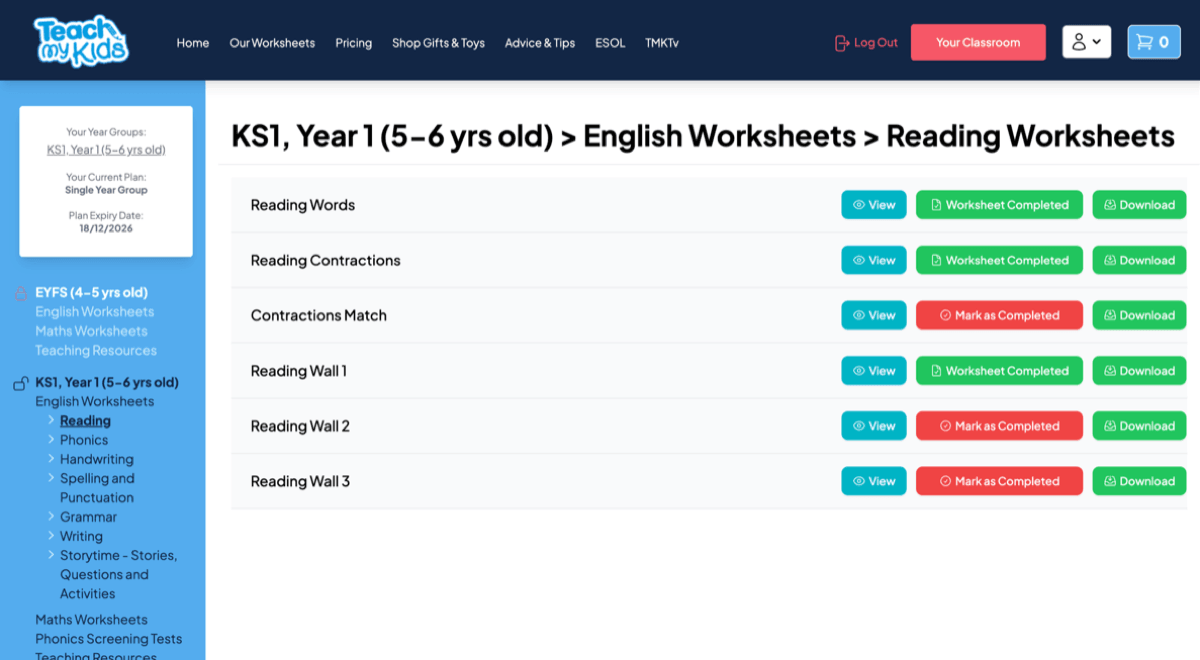
This is your child's online classroom.
You're not buying a single worksheet. You log in to a space set up for your child, where the full library unlocks and everything stays in one place.
-
1.
Your own space, any time.
A login for your family. No app to install. Open it whenever suits you.
-
2.
Set to your child's year.
Pick their year group and the right worksheets unlock. Move it up as they grow.
-
3.
The whole library unlocks.
Every worksheet for their year in maths and English, matched to the school curriculum and sorted by topic. Not one sheet, all of them.
-
4.
Print what you need, when you need it.
The whole library is open, so you print this week's topics when they come up at school. No daily limit and nothing to ration. Come back as often as you like.
-
5.
Tick off what's done.
Mark each worksheet as done so you can see what your child has covered.
Common questions
Questions parents ask
- Are the worksheets made by a teacher?
- Yes. Every worksheet is created by an experienced UK primary school teacher and mapped to the national curriculum, so what your child practises lines up with school.
- How does Teach My Kids work?
- Set your child's year group and the matching maths and English worksheets unlock. Print what you need at home, sit together for ten minutes, then tick off what they have finished.
- Can I print the worksheets at home?
- Yes. They are built for paper, so you print them at home and your child works away from a screen. That is the whole point: structured practice, off the device.
Year groups
Set your child's year and their library unlocks.
Every year is mapped to the UK curriculum. Pick the year your child is in and that whole library opens up. Move it up as they grow, or drop back a year if they need to catch up.
From the kitchen table
From parents who already print at home.
Real parents, phonics through to SATs.

Putting Your Child's Education First


Worksheets by year and topic
- Reception maths worksheets
- Year 1 maths worksheets
- Year 2 maths worksheets
- Year 3 maths worksheets
- Year 4 maths worksheets
- Year 5 maths worksheets
- Year 6 maths worksheets
- Year 1 English worksheets
- Year 2 English worksheets
- Year 3 English worksheets
- Year 4 English worksheets
- Year 5 English worksheets
- Year 6 English worksheets
- Times tables worksheets
- Multiplication worksheets
- Division worksheets
- Fractions worksheets
- Decimals worksheets
- Percentages worksheets
- Place value worksheets
- Addition worksheets
- Subtraction worksheets
- Telling the time worksheets
- Shape worksheets
- Grammar worksheets
- Fronted adverbials
- Adverbs worksheets
- Nouns worksheets
- Verbs worksheets
- Adjectives worksheets
- Spelling worksheets
- Handwriting worksheets
- Phonics worksheets
- Phase 5 phonics
- KS2 SATs papers
- KS1 SATs papers
- Year 6 SATs
- Browse all worksheets →
All rights reserved © Teach My Kids 2026. Site designed and built by BillyMedia