Simple Ways to Encourage Your Children to Learn and Achieve
Maths and English worksheets for your child's year group, made by Sunita, an experienced UK primary school teacher. Print them at home and sit together for ten minutes.

Free trial, no card
Try the classroom free for 7 days
Sign up free, pick your child's year group and print 3 worksheets this week. Made by a UK primary school teacher, yours to use at the kitchen table.
- ✓Made by an experienced UK primary school teacher
- ✓Mapped to the national curriculum, Reception to Year 6
- ✓Print at home and work on paper, no screen needed
No card needed. One teacher, every worksheet.

As parents, our role in shaping our children's educational journey is crucial, especially during their years in primary school.
Establishing a positive and supportive home environment can significantly impact children's love for learning.
Use the Learn and Achieve pack (put together by the DFE, using research carried out to identify what parents need to help their Primary School children and engage with them at home) to help you improve your child's learning.
The pack includes wallcharts, information, ideas and games on how to make homework and learning part of their family routine. A link to the pack is at the end of this article.
You can also use these tips to help you to inspire your learning and achievement with your child:
1. Cultivate a Positive Home Environment:
Creating a positive and welcoming atmosphere at home is the foundation for success. Decorate study spaces with vibrant colours, engaging materials, and uplifting messages. Encourage open communication, and strive to build strong, positive relationships within the family.
2. Spark the Joy of Learning:
Make learning enjoyable for your child by incorporating interactive and hands-on activities at home. Utilise educational games, experiments, and family field trips to make lessons come alive. Fostering a love for learning sets the stage for a lifetime of curiosity.
3. Set Realistic Goals Together:
Involve your child in setting achievable goals. Break down aspirations into manageable steps, and celebrate small victories as a family. This not only instills a sense of accomplishment but also encourages a growth mindset that embraces challenges as part of the learning process.
4. Recognise Your Child’s Learning Style:
Understanding your child's unique learning style is crucial. Tailor your approach to accommodate their strengths and preferences, ensuring a personalised learning experience that resonates with your child.
5. Encourage Critical Thinking at Home:
Stimulate your child's critical thinking skills by engaging them in thought-provoking conversations. Create an environment where they feel comfortable expressing their thoughts and ideas. Encouraging them to solve problems independently fosters valuable skills for academic success.
6. Foster a Growth Mindset:
Teach your child the importance of effort and perseverance. Emphasise that intelligence and skills can be developed through hard work. Help them view setbacks as opportunities to learn and grow, nurturing resilience that will benefit them throughout their academic journey.
7. Stay Actively Involved:
Collaborate with teachers and stay actively involved in your child's education. Regularly communicate with educators, attend parent-teacher meetings, and participate in school activities. This partnership fosters a supportive learning environment that encourages your child to excel.
8. Embrace Diversity Together:
Introduce your child to diverse cultures, perspectives, and experiences. Celebrate differences and teach them the value of empathy and respect. By embracing diversity as a family, you contribute to creating a positive learning environment where everyone feels valued and accepted.
As parents, we have the opportunity to nurture our children's love for learning and set them on a path to success.
By creating a positive home environment, setting achievable goals, embracing diversity, and fostering a growth mindset, we empower our primary-aged children to not only learn but to thrive and achieve their full potential.
Buy Story Books For Kids
Download Your Free Learn and Achieve Pack
Need Maths and English Worksheets?
Join Teach My Kids today to improve your child's Maths and English Skills.
Photo by Greg Rosenke


Who makes the worksheets
Sunita
UK primary teacher
Every worksheet on Teach My Kids is made by Sunita, a UK primary school teacher with over ten years in the classroom. She writes each one by hand and maps it to the national curriculum, so what your child practises at home lines up with what they do at school. It's all on paper, not a screen, and takes about ten minutes a day.
Try the classroom freeWhat you're joining
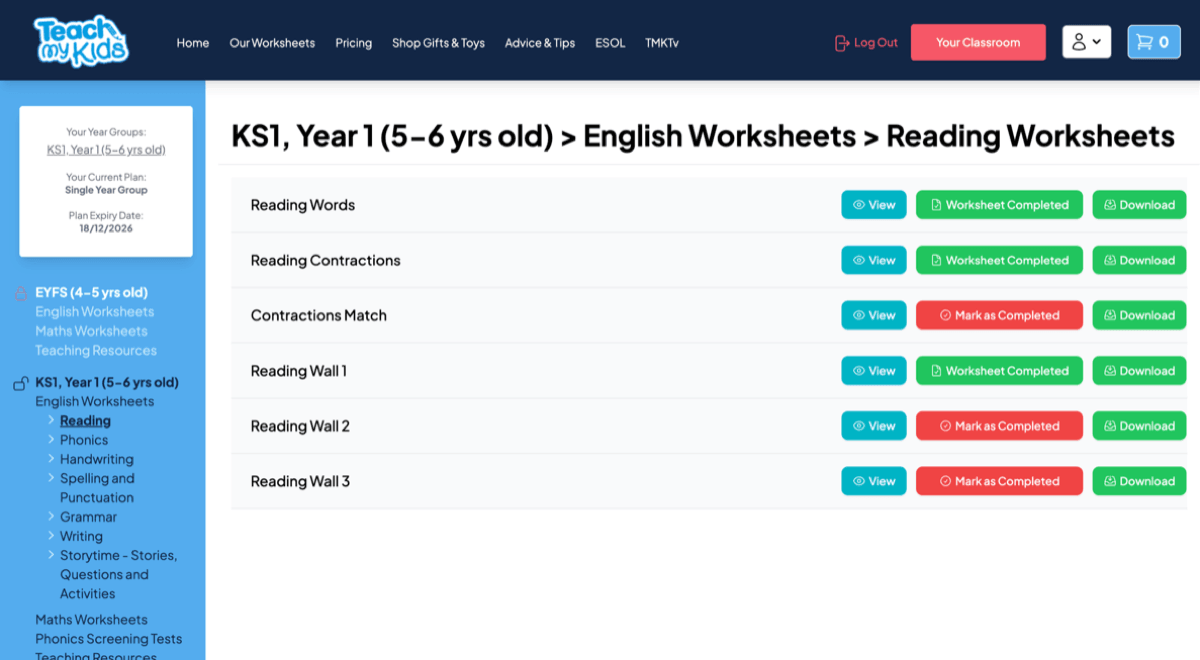
This is your child's online classroom.
You're not buying a single worksheet. You log in to a space set up for your child, where the full library unlocks and everything stays in one place.
-
1.
Your own space, any time.
A login for your family. No app to install. Open it whenever suits you.
-
2.
Set to your child's year.
Pick their year group and the right worksheets unlock. Move it up as they grow.
-
3.
The whole library unlocks.
Every worksheet for their year in maths and English, matched to the school curriculum and sorted by topic. Not one sheet, all of them.
-
4.
Print what you need, when you need it.
The whole library is open, so you print this week's topics when they come up at school. No daily limit and nothing to ration. Come back as often as you like.
-
5.
Tick off what's done.
Mark each worksheet as done so you can see what your child has covered.
Common questions
Questions parents ask
- Are the worksheets made by a teacher?
- Yes. Every worksheet is created by an experienced UK primary school teacher and mapped to the national curriculum, so what your child practises lines up with school.
- How does Teach My Kids work?
- Set your child's year group and the matching maths and English worksheets unlock. Print what you need at home, sit together for ten minutes, then tick off what they have finished.
- Can I print the worksheets at home?
- Yes. They are built for paper, so you print them at home and your child works away from a screen. That is the whole point: structured practice, off the device.
Year groups
Set your child's year and their library unlocks.
Every year is mapped to the UK curriculum. Pick the year your child is in and that whole library opens up. Move it up as they grow, or drop back a year if they need to catch up.
From the kitchen table
From parents who already print at home.
Real parents, phonics through to SATs.

Putting Your Child's Education First


Worksheets by year and topic
- Reception maths worksheets
- Year 1 maths worksheets
- Year 2 maths worksheets
- Year 3 maths worksheets
- Year 4 maths worksheets
- Year 5 maths worksheets
- Year 6 maths worksheets
- Year 1 English worksheets
- Year 2 English worksheets
- Year 3 English worksheets
- Year 4 English worksheets
- Year 5 English worksheets
- Year 6 English worksheets
- Times tables worksheets
- Multiplication worksheets
- Division worksheets
- Fractions worksheets
- Decimals worksheets
- Percentages worksheets
- Place value worksheets
- Addition worksheets
- Subtraction worksheets
- Telling the time worksheets
- Shape worksheets
- Grammar worksheets
- Fronted adverbials
- Adverbs worksheets
- Nouns worksheets
- Verbs worksheets
- Adjectives worksheets
- Spelling worksheets
- Handwriting worksheets
- Phonics worksheets
- Phase 5 phonics
- KS2 SATs papers
- KS1 SATs papers
- Year 6 SATs
- Browse all worksheets →
All rights reserved © Teach My Kids 2026. Site designed and built by BillyMedia