How to Help Children Easily Learn to Count, Add and Subtract
Maths and English worksheets for your child's year group, made by Sunita, an experienced UK primary school teacher. Print them at home and sit together for ten minutes.

Free trial, no card
Every Year 1 maths worksheet, mapped to the curriculum
Sign up free, pick your child's year group and print 3 worksheets this week. Made by a UK primary school teacher, yours to use at the kitchen table.
- ✓Made by an experienced UK primary school teacher
- ✓Mapped to the national curriculum, Reception to Year 6
- ✓Print at home and work on paper, no screen needed
No card needed. One teacher, every worksheet.

Helping children aged 4-5 with maths, counting, adding, and subtracting is an essential foundation for their future learning, both at home and at school.
At this age, children are just beginning to understand numbers, so making the maths learning process fun and interactive is key. These early maths skills not only support their overall development but also align with the Primary National Curriculum objectives.
Activities For Children That help develop Early Maths Skills
- Counting Practise
Start by introducing counting with simple, everyday objects. Use toys, blocks, or even snacks to make counting fun.
Buy Maths Counting Games and Resources
For example, ask children, “How many apples do we have?” or “Can you count the blocks in this pile?”
Count with them and encourage them to say the numbers out loud.
You can also count things during everyday activities, like steps as you walk or the number of cars passing by. The goal is to get children familiar with numbers and counting as part of daily life.
How counting practise using objects helps at school:
Counting is one of the first maths skills children are introduced to in school.
By practising counting at home, children will be more confident in class when asked to count objects or recognise numbers. It helps them develop number sense, which is the ability to understand and work with numbers.
This directly ties into the Early Years Foundation Stage (EYFS) framework of the Primary National Curriculum, which emphasises developing children’s ability to count reliably and use numbers up to 20 by the end of reception year.
- Adding with Objects
Once children are comfortable with counting, you can introduce basic addition.
The key here is to keep it simple and concrete. Use small objects such as buttons, coins, or blocks to show how numbers come together.
Buy Maths Counting Games and Resources
For example, you could say, “We have 2 buttons here, and if we add 1 more, how many do we have now?” Let children count the total.
Hands-on maths activities like this help children visualise what addition means, making the concept easier to understand.
How adding with objects helps at school:
Addition is one of the first steps towards understanding more complex maths concepts.
By practising simple addition at home, children will be better prepared when they start to learn about combining numbers in school.
In the early years curriculum at school, children are expected to use everyday objects to add and begin solving practical problems. Being comfortable with addition at an early age ensures they can meet these objectives more easily and feel more confident in the classroom. - Simple Subtraction
Just like with addition, using objects to explain subtraction helps young children understand the concept of taking away.
You can start with something simple, like a snack: “We have 3 biscuits, but if we eat 1, how many are left?”
As with addition, allowing children to physically remove an object and count what remains helps them grasp the idea of subtraction. Keep the numbers small to avoid overwhelming them.
How this helps at school:
Subtraction is another key skill in the early years numeracy curriculum.
Teachers often use objects or visual aids to teach subtraction in the classroom, so reinforcing this at home gives children a head start.
The EYFS curriculum aims for children to solve practical problems involving subtraction by the end of reception, so practising these maths skills early will ensure they are on track to meet these goals.
Join Teach My Kids to gain access to a whole year's worth of Maths and English worksheets.
- Number Songs and Games
Incorporating number songs and games into daily routines is a fun way to strengthen counting, adding, and subtracting skills.
Songs like “Five Little Ducks” or “Ten in the Bed” teach children how to count backwards, introducing subtraction in a playful way. Similarly, games like hopscotch, board games with dice, or simple number-matching games help children recognise and understand numbers in a fun, low-pressure environment.
Buy Maths Counting Stories
Buy Maths Games for Kids
How number songs and games helps at school:
Songs and games provide a multi-sensory learning experience that can reinforce what children are learning in numeracy at school.
Buy Maths Counting Stories
The Primary National Curriculum encourages learning through play in the early years, as it helps children engage with numbers without feeling like they are doing “work.” By using these fun maths activities in everyday life, you are reinforcing important skills in a way that is similar with classroom learning strategies.
- Use Everyday Situations to Practise
Using numbers in daily activities is a powerful way to help children develop their maths skills.
When shopping, ask children to count items as you put them into the trolley, or when setting the table, ask, “We need 4 plates for dinner. Can you count how many we have?”
These real-life experiences allow children to practise counting and simple maths in a practical context.
How everyday counting at home helps at school:
The Primary National Curriculum emphasises the importance of problem-solving and using numbers in everyday contexts.
By practising counting and basic maths at home in everyday situations, children will develop practical numeracy skills that will help them meet the curriculum’s goals.
This early practise makes it easier for them to solve problems and understand the importance of maths in real life once they enter school.
How Early Maths Practise Fits with National Curriculum Numeracy Objectives
In the Early Years Foundation Stage (EYFS) curriculum, children aged 4-5 are expected to develop a strong understanding of numbers, counting, and basic addition and subtraction.
By the end of the reception year, the numeracy goal is for children to count reliably up to 20, solve problems involving doubling, halving, and sharing, and begin to add and subtract using objects or pictures.
By helping children at home with counting, adding, and subtracting, you are giving them a strong foundation that will help them meet these Numeracy National Curriculum objectives. The more comfortable they are with these early maths skills, the more confident they will be when tackling new maths challenges in school. This early maths support will ensure they enter their first years of formal education with the skills they need to succeed and enjoy learning.
Helping children aged 4-5 with counting, adding, and subtracting is an important step in building their confidence and readiness for school.
By using fun, hands-on maths activities and using maths into everyday life, parents can support their children’s learning in a way that feels natural and engaging.
These early numeracy skills not only prepare children for classroom success but also align with the maths National Curriculum goals, ensuring they develop a strong understanding of numbers by the end of their reception year.
Starting early makes learning maths a positive experience that will benefit children throughout their education.
Join Teach My Kids to gain access to a whole year's worth of Maths and English worksheets.
Image by KATRIN BOLOVTSOVA


Who makes the worksheets
Sunita
UK primary teacher
Every worksheet on Teach My Kids is made by Sunita, a UK primary school teacher with over ten years in the classroom. She writes each one by hand and maps it to the national curriculum, so what your child practises at home lines up with what they do at school. It's all on paper, not a screen, and takes about ten minutes a day.
Try the classroom freeWhat you're joining
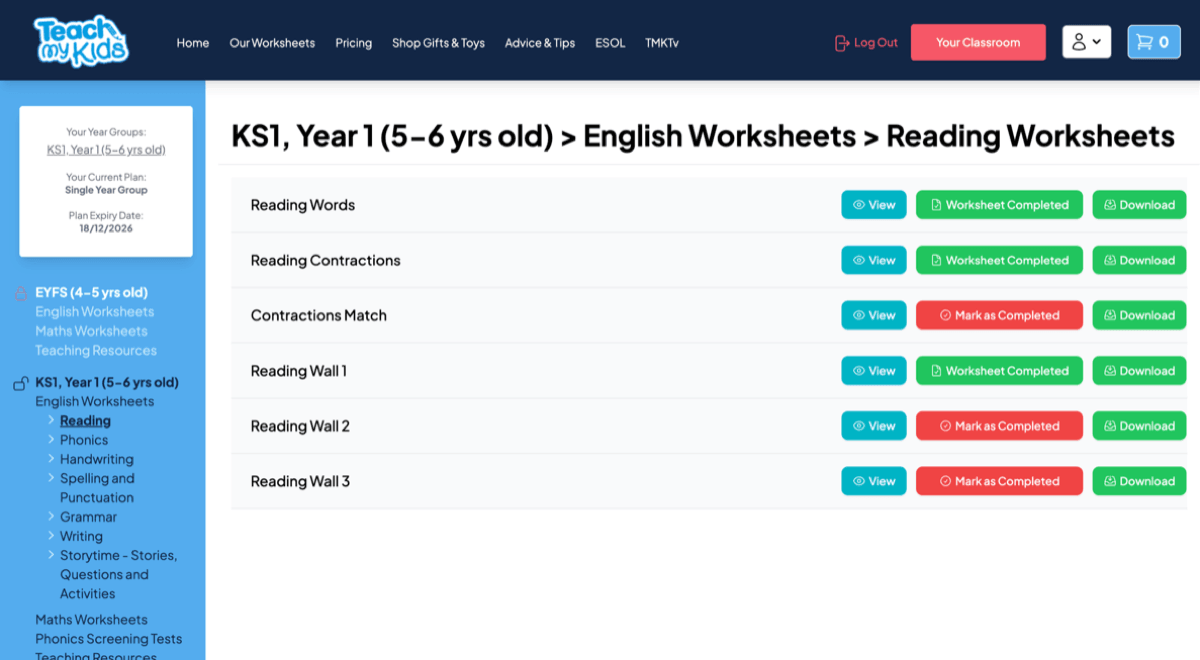
This is your child's online classroom.
You're not buying a single worksheet. You log in to a space set up for your child, where the full Year 1 library unlocks and everything stays in one place.
-
1.
Your own space, any time.
A login for your family. No app to install. Open it whenever suits you.
-
2.
Set to your child's year.
Pick their year group and the right worksheets unlock. Move it up as they grow.
-
3.
The whole library unlocks.
Every worksheet for their year in maths and English, matched to the school curriculum and sorted by topic. Not one sheet, all of them.
-
4.
Print what you need, when you need it.
The whole library is open, so you print this week's topics when they come up at school. No daily limit and nothing to ration. Come back as often as you like.
-
5.
Tick off what's done.
Mark each worksheet as done so you can see what your child has covered.
Common questions
Questions parents ask
- What does partitioning mean in maths?
- Partitioning means splitting a number into its parts, usually hundreds, tens and units. So 342 becomes 300, 40 and 2. It helps a child see how numbers are built, which makes adding and subtracting easier.
- How do I teach place value at home?
- Start with real objects your child can group into tens and ones, then move to writing the numbers down. Ask what each digit is worth. In 56, the 5 is worth fifty, not five. Keep the numbers small at first, then build up.
- Why is partitioning useful?
- It makes bigger sums less daunting. Once a child can break a number into hundreds, tens and units, they can work on each part on its own, then put it back together. It is the thinking behind most written methods.
From the kitchen table
From parents who already print at home.
Real parents, phonics through to SATs.
Putting Your Child's Education First


Worksheets by year and topic
- Reception maths worksheets
- Year 1 maths worksheets
- Year 2 maths worksheets
- Year 3 maths worksheets
- Year 4 maths worksheets
- Year 5 maths worksheets
- Year 6 maths worksheets
- Year 1 English worksheets
- Year 2 English worksheets
- Year 3 English worksheets
- Year 4 English worksheets
- Year 5 English worksheets
- Year 6 English worksheets
- Times tables worksheets
- Multiplication worksheets
- Division worksheets
- Fractions worksheets
- Decimals worksheets
- Percentages worksheets
- Place value worksheets
- Addition worksheets
- Subtraction worksheets
- Telling the time worksheets
- Shape worksheets
- Grammar worksheets
- Fronted adverbials
- Adverbs worksheets
- Nouns worksheets
- Verbs worksheets
- Adjectives worksheets
- Spelling worksheets
- Handwriting worksheets
- Phonics worksheets
- Phase 5 phonics
- KS2 SATs papers
- KS1 SATs papers
- Year 6 SATs
- Browse all worksheets →
All rights reserved © Teach My Kids 2026. Site designed and built by BillyMedia