Top Tips On How To Become A Better Teacher
Maths and English worksheets for your child's year group, made by Sunita, an experienced UK primary school teacher. Print them at home and sit together for ten minutes.

Free trial, no card
Try the classroom free for 7 days
Sign up free, pick your child's year group and print 3 worksheets this week. Made by a UK primary school teacher, yours to use at the kitchen table.
- ✓Made by an experienced UK primary school teacher
- ✓Mapped to the national curriculum, Reception to Year 6
- ✓Print at home and work on paper, no screen needed
No card needed. One teacher, every worksheet.

Following a career in teaching can be both rewarding and challenging, especially for new teachers or those facing struggles with organisation.
Teachers can create an efficient, engaging, and impactful classroom environment by using proven strategies.
Become a better teacher by using our tips below:
- Regular Assessments, Personalised Attention and Differentiated Lessons
Teachers need to recognise children's varied learning styles and paces. Regular assessments, personalised attention and differentiated work / instructions are crucial to ensuring every child's progress.
By differentiating lessons to individual children's needs, teachers can create an inclusive atmosphere that supports academic growth based on children's needs and achievements. - Planners, Calendars, To-Do Lists and a Well-Organised Classroom
Organisational skills are essential when teaching and planning lessons. Using planners, calendars and to-do lists will help you keep on top of assessments, marking, planning lessons, attending meetings and training sessions to name a few things that teachers need to keep on top of!
A well organised classroom is also essential. By arranging both physical and digital materials, time spent looking for lesson resources reduces, allowing teachers to free up more time to the actual task of teaching and making their lessons fun and exciting rather than turning it into an administrative task. Teachers can also make use of various online educational resources such as Storytime and Teach My Kids Maths and English Worksheets - Assessing Your Teaching Methods And Lessons
Personal self assessment of your lesson plans, how you taught a skill or concept to children during a lesson is one of the most important factors to improving as a primary school teacher.
As a class teacher finding the best, or most effective strategies that work with the children in your class is an important skill. If you know which teaching strategies work best with the children in your class, or with specific children, you can take advantage of this knowledge when trying to explain more difficult concepts. Remember, children learn best in different ways, some children might prefer to see things visually, whereas others may benefit from demonstrations or modelling. Keeping a teaching journal will help you keep track of lessons, strategies and techniques that went well, which in turn will make you a better teacher.
- How Technology Can Help Teachers
Digitise your teaching resources, lesson plans, records etc into easily-shareable PDFs, powerpoints etc to reduce clutter, increase accessibility and the ability to share them with other teachers and classroom assistants. It will also save you time when you need to adapt resources to meet the needs of a specific child or group of children, or if you want to reuse it again in future years. This is also helpful if you need to share lesson plans, especially if you work in a primary school that have a two form entry or more for each year group.
For better organisation, teachers can save lesson plans and resources by categorising them by subject and/or level.
Use Teach My Kids Worksheets! Ready to print maths and english worksheets, organised into year groups and topic areas to save you valuable teaching and planning time. - Create a Memorable Learning Experience In Your Classroom
A visually appealing, interactive classroom focussed on teaching and learning will help enthuse children to learn. Displaying children's work will give them a sense of achievement and pride, as well as modelling work. A thoughtfully designed classroom will engages children's senses and imagination, making learning a memorable experience.
Teachers can also make use of areas and display boards to demonstrate or visually display expectations or answers to commonly repeated processes or questions e.g. displaying routines, frequently used spellings, times tables etc. - Effective Classroom Management Facilitates Learning
Establish clear and consistent classroom rules and routines. Create positive behaviour reinforcement strategies and address challenges promptly to maintain a happy learning environment. Effective classroom management minimises disruptions and allows children to take ownership of their behaviour and learning journey. - Break Down Large / Difficult Concepts Into Smaller Steps
Explaining and teaching difficult concepts to primary aged children can be difficult. Sometimes the Primary National Curriculum will set objectives that the children in your class need to achieve, but what if they just don't understand it?
- Don't be scared to break difficult learning objectives or concepts into smaller chunks.
- Don't be scared to go back a step.
- Don't be scared to recap, or go over previously taught skills or information covered in previous years.
Children need to build on what they know and what they have learnt. There is no point in spending a whole lesson trying to get children to understand something when they haven't been taught or understood the basics and foundations. Many teachers will carry on trying to get children to understand what is in their lesson plan. A good teacher will see that the children are not understanding and will break the concept up into smaller chunks or demonstrate a simpler version before moving on to the concept / objective in their lesson plan.
Having more manageable milestones will keep children motivated to keep learning and will create a better sense of achievement.
Organisational skills are at the heart of successful teaching. Tailoring teaching strategies and resources, breaking concepts and skills into manageable steps, using digital tools and resources and creating impactful learning environments can help teachers free up more time and overcome some of the challenges they will face.
To bridge the gap between school and home and create confident learners, JOIN Teach My Kids today!
Image via Pexels


Who makes the worksheets
Sunita
UK primary teacher
Every worksheet on Teach My Kids is made by Sunita, a UK primary school teacher with over ten years in the classroom. She writes each one by hand and maps it to the national curriculum, so what your child practises at home lines up with what they do at school. It's all on paper, not a screen, and takes about ten minutes a day.
Try the classroom freeWhat you're joining
This is your child's online classroom.
You're not buying a single worksheet. You log in to a space set up for your child, where the full library unlocks and everything stays in one place.
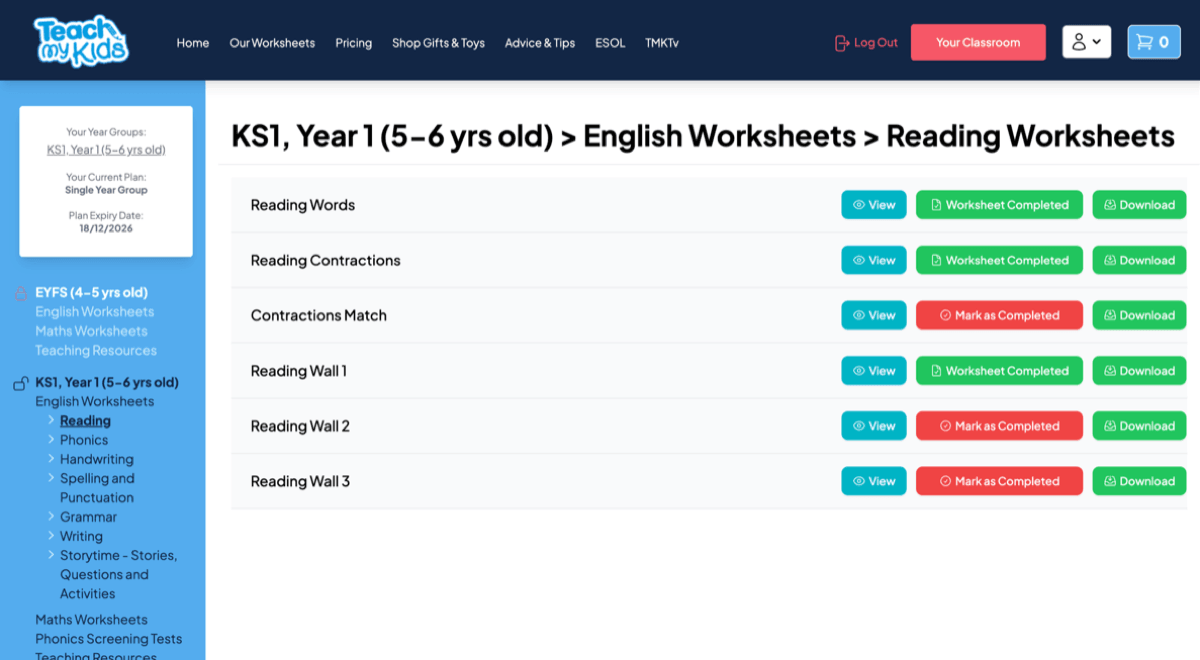
-
1.
Your own space, any time.
A login for your family. No app to install. Open it whenever suits you.
-
2.
Set to your child's year.
Pick their year group and the right worksheets unlock. Move it up as they grow.
-
3.
The whole library unlocks.
Every worksheet for their year in maths and English, matched to the school curriculum and sorted by topic. Not one sheet, all of them.
-
4.
Print what you need, when you need it.
The whole library is open, so you print this week's topics when they come up at school. No daily limit and nothing to ration. Come back as often as you like.
-
5.
Tick off what's done.
Mark each worksheet as done so you can see what your child has covered.
Common questions
Questions parents ask
- Are the worksheets made by a teacher?
- Yes. Every worksheet is created by an experienced UK primary school teacher and mapped to the national curriculum, so what your child practises lines up with school.
- How does Teach My Kids work?
- Set your child's year group and the matching maths and English worksheets unlock. Print what you need at home, sit together for ten minutes, then tick off what they have finished.
- Can I print the worksheets at home?
- Yes. They are built for paper, so you print them at home and your child works away from a screen. That is the whole point: structured practice, off the device.
Year groups
Set your child's year and their library unlocks.
Every year is mapped to the UK curriculum. Pick the year your child is in and that whole library opens up. Move it up as they grow, or drop back a year if they need to catch up.
From the kitchen table
From parents who already print at home.
Real parents, phonics through to SATs.

Putting Your Child's Education First


Worksheets by year and topic
- Reception maths worksheets
- Year 1 maths worksheets
- Year 2 maths worksheets
- Year 3 maths worksheets
- Year 4 maths worksheets
- Year 5 maths worksheets
- Year 6 maths worksheets
- Year 1 English worksheets
- Year 2 English worksheets
- Year 3 English worksheets
- Year 4 English worksheets
- Year 5 English worksheets
- Year 6 English worksheets
- Times tables worksheets
- Multiplication worksheets
- Division worksheets
- Fractions worksheets
- Decimals worksheets
- Percentages worksheets
- Place value worksheets
- Addition worksheets
- Subtraction worksheets
- Telling the time worksheets
- Shape worksheets
- Grammar worksheets
- Fronted adverbials
- Adverbs worksheets
- Nouns worksheets
- Verbs worksheets
- Adjectives worksheets
- Spelling worksheets
- Handwriting worksheets
- Phonics worksheets
- Phase 5 phonics
- KS2 SATs papers
- KS1 SATs papers
- Year 6 SATs
- Browse all worksheets →
All rights reserved © Teach My Kids 2026. Site designed and built by BillyMedia