Encouraging A Reluctant Reader
Maths and English worksheets for your child's year group, made by Sunita, an experienced UK primary school teacher. Print them at home and sit together for ten minutes.

Free trial, no card
Try the classroom free for 7 days
Sign up free, pick your child's year group and print 3 worksheets this week. Made by a UK primary school teacher, yours to use at the kitchen table.
- ✓Made by an experienced UK primary school teacher
- ✓Mapped to the national curriculum, Reception to Year 6
- ✓Print at home and work on paper, no screen needed
No card needed. One teacher, every worksheet.

Reading is an essential life skill.
Children who choose to read books for pleasure and enjoyment will ultimately do better in literacy.
At school children are encouraged to read regularly and it is recommended that they read for 30 minutes every day. Reading every day will help children develop their writing skills, as well as improving their vocabulary and spelling.
Is Your Child A Reluctant Reader?
Quick Tips To encourage a reluctant child to read
- When out and about:
Ask children to read road signs, leaflets, menus etc can also help. This can then be extended by asking questions such as "Which way should we go now? What ingredients are in main course of the meal? What facilities are available in the theme park? When does the shop open?" - Choose Interesting Books:
Find books that align with your child's interests, hobbies, or favourite topics. This can make reading more enjoyable. - Set a Reading Routine:
Establish a consistent reading routine, such as reading together before bedtime. Predictable reading times can create a positive habit. - Be a Reading Role Model:
Demonstrate a love for reading by letting your child see you enjoy books. Children often emulate the behaviours of adults. - Visit the Library:
Take regular trips to the library and allow your child to select books. The wide variety of choices can spark their interest. - Use Technology:
Explore e-books, audiobooks, or interactive reading apps. Some children might find technology-based reading more engaging. - Create a Reading Nook:
Set up a cozy and comfortable reading space at home. Having a dedicated area for reading can make the activity more inviting. - Read Aloud Together:
Share the reading experience by taking turns reading aloud. This can be a bonding activity and can make reading more enjoyable. - Connect Books to Real Life:
Relate the content of the books to real-life experiences. Discuss how characters in the story might handle situations similar to those in your child's life. - Celebrate Achievements:
Acknowledge and celebrate your child's reading accomplishments. Positive reinforcement can boost their confidence and motivation. - Explore Different Formats:
Don't limit reading to traditional books. Explore comic books, magazines, or graphic novels. Different formats may capture your child's interest. - Be Patient and Supportive:
Understand that building a love for reading takes time. Be patient, and provide encouragement and support along the wa
Join Teach My Kids to gain access to a whole year's worth of Maths and English worksheets.
Questions and Prompts To Ask A Child When Reading A Book
- Discuss the characters, setting, beginning, middle and end of the story will help Primary School children understand and enjoy stories.
- Ask children more open-ended questions such as 'How could you change the ending? Which is your favourite character and why? Why would you recommend this book to other children?' This will encourage them to give their own opinion about the book.
Download A Free Book Review Template
Click on the download button below for a book review template.
Teach My Kids - Activities for children:
Ask your child to choose a short story to read. Then use this literacy writing template to write a book review. Your child can write in full sentences or bullet point answers.
Join Teach My Kids to gain access to a whole year's worth of Maths and English worksheets.
You might also like to read:
6 Ways To Encourage Your Child To Retell A Story
Reading Strategies - Help Your Child Improve Their Reading
How To Improve Your Child's Creative Writing
Top Ten Tips For Getting Homework Survival
Top Tips For Reading Together With Your Child
Free Worksheets:
Photo by Josh Applegate


Who makes the worksheets
Sunita
UK primary teacher
Every worksheet on Teach My Kids is made by Sunita, a UK primary school teacher with over ten years in the classroom. She writes each one by hand and maps it to the national curriculum, so what your child practises at home lines up with what they do at school. It's all on paper, not a screen, and takes about ten minutes a day.
Try the classroom freeWhat you're joining
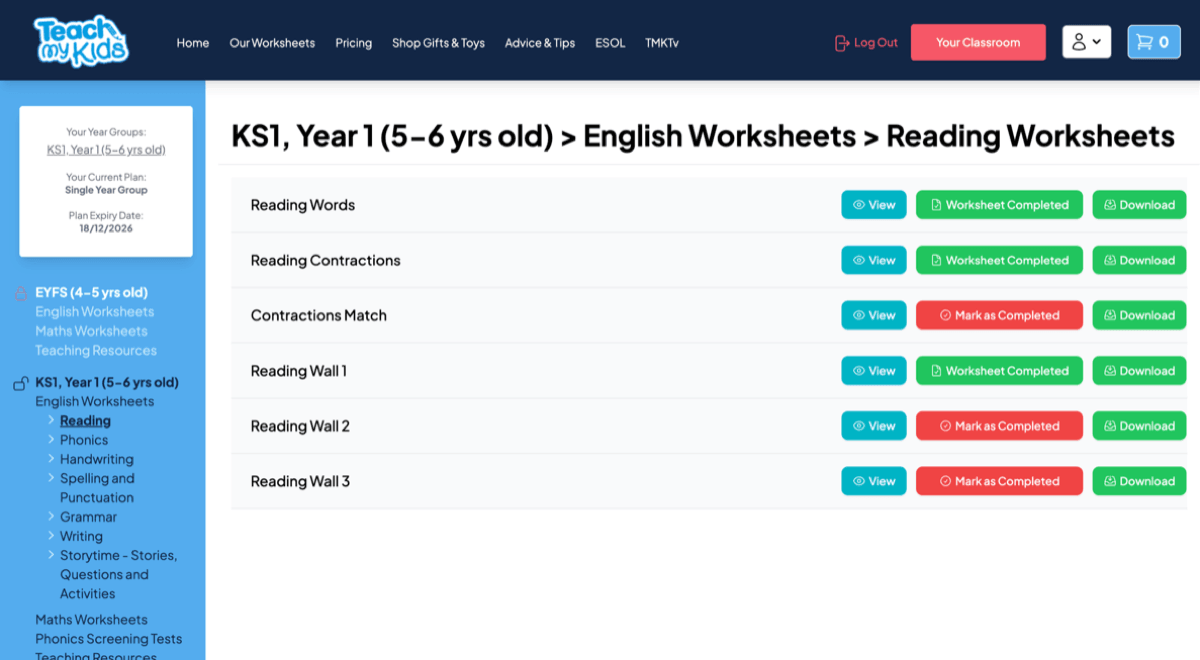
This is your child's online classroom.
You're not buying a single worksheet. You log in to a space set up for your child, where the full library unlocks and everything stays in one place.
-
1.
Your own space, any time.
A login for your family. No app to install. Open it whenever suits you.
-
2.
Set to your child's year.
Pick their year group and the right worksheets unlock. Move it up as they grow.
-
3.
The whole library unlocks.
Every worksheet for their year in maths and English, matched to the school curriculum and sorted by topic. Not one sheet, all of them.
-
4.
Print what you need, when you need it.
The whole library is open, so you print this week's topics when they come up at school. No daily limit and nothing to ration. Come back as often as you like.
-
5.
Tick off what's done.
Mark each worksheet as done so you can see what your child has covered.
Common questions
Questions parents ask
- Are the worksheets made by a teacher?
- Yes. Every worksheet is created by an experienced UK primary school teacher and mapped to the national curriculum, so what your child practises lines up with school.
- How does Teach My Kids work?
- Set your child's year group and the matching maths and English worksheets unlock. Print what you need at home, sit together for ten minutes, then tick off what they have finished.
- Can I print the worksheets at home?
- Yes. They are built for paper, so you print them at home and your child works away from a screen. That is the whole point: structured practice, off the device.
Year groups
Set your child's year and their library unlocks.
Every year is mapped to the UK curriculum. Pick the year your child is in and that whole library opens up. Move it up as they grow, or drop back a year if they need to catch up.
From the kitchen table
From parents who already print at home.
Real parents, phonics through to SATs.

Putting Your Child's Education First


Worksheets by year and topic
- Reception maths worksheets
- Year 1 maths worksheets
- Year 2 maths worksheets
- Year 3 maths worksheets
- Year 4 maths worksheets
- Year 5 maths worksheets
- Year 6 maths worksheets
- Year 1 English worksheets
- Year 2 English worksheets
- Year 3 English worksheets
- Year 4 English worksheets
- Year 5 English worksheets
- Year 6 English worksheets
- Times tables worksheets
- Multiplication worksheets
- Division worksheets
- Fractions worksheets
- Decimals worksheets
- Percentages worksheets
- Place value worksheets
- Addition worksheets
- Subtraction worksheets
- Telling the time worksheets
- Shape worksheets
- Grammar worksheets
- Fronted adverbials
- Adverbs worksheets
- Nouns worksheets
- Verbs worksheets
- Adjectives worksheets
- Spelling worksheets
- Handwriting worksheets
- Phonics worksheets
- Phase 5 phonics
- KS2 SATs papers
- KS1 SATs papers
- Year 6 SATs
- Browse all worksheets →
All rights reserved © Teach My Kids 2026. Site designed and built by BillyMedia